
Advanced Solar Tracker Manufacturers' Requirements for Predictive Atmospheric Storm Modeling Integration
September 05, 2026
Predictive atmospheric storm models can give solar trackers advance information about approaching high-wind events, allowing tracker control systems to adjust operating positions before severe weather arrives. For utility-scale projects, this connection between weather forecasting and tracker control is becoming an important consideration when evaluating solar tracker manufacturers. Rather than relying only on fixed wind thresholds or real-time sensor readings, an integrated platform can use forecast data to support earlier and more informed stow decisions.
Research from the National Renewable Energy Laboratory (NREL) highlights this challenge. Its PVade research combines fluid and structural solvers to study unsteady wind loading and dynamic instability in single-axis trackers. The objective is to help evaluate tracker hardware, array layouts, and stow strategies under changing wind conditions.
For us, this demonstrates why advanced solar tracker manufacturers need to think beyond static wind-load calculations. Atmospheric models can provide evolving information that helps control systems make better decisions before hazardous conditions reach their peak.
The next step is converting that information into actionable tracker commands. Rather than waiting for a threshold to be exceeded, an intelligent control platform could evaluate forecast trends together with real-time measurements and determine whether a safer tracker position is appropriate.
Such an approach complements rather than replaces established structural engineering. ASCE/SEI 7-22 provides minimum design-load criteria and includes provisions addressing wind effects and mounted solar arrays. Predictive control adds an operational layer to the engineered structural envelope.
These requirements are especially relevant because wind-induced tracker behavior can involve complex fluid-structure interactions. NREL research has examined phenomena such as torsional galloping and the relationship between wind conditions and tracker stability. A robust platform therefore needs coordinated mechanical design, sensing, communications, and software.
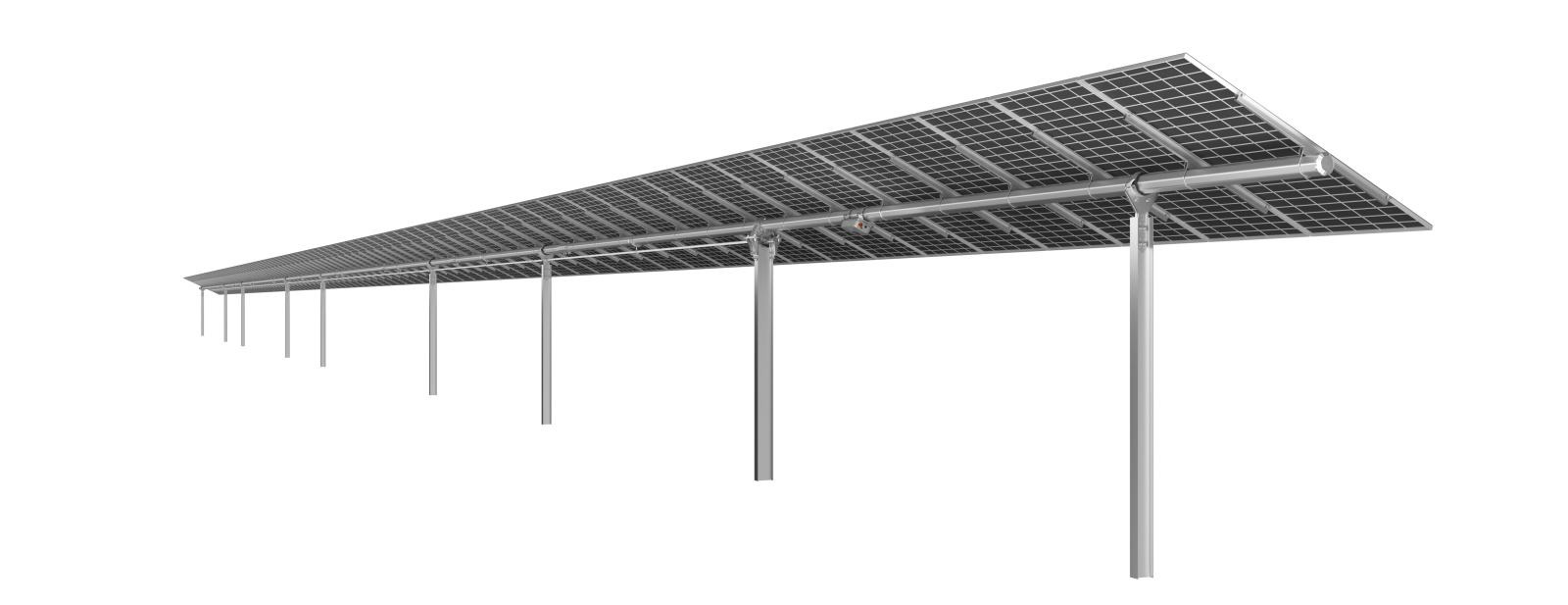
The TAI-Universal is a 2P multiple-slew-drive single-axis independent solar tracking system. Its published specifications include a 120° tracking range, two to four slewing reducers, a 5° wind-stow angle, and 20% north-south slope tolerance. The system also supports large-format modules and bifacial-module applications.
Its mechanical configuration is designed to distribute forces across multiple points. We also incorporate wireless communication and backup battery capability so tracker functionality can be maintained during grid outages. These features are important when severe weather affects both structural loading and site power availability.
Our SmartTrail approach already emphasizes intelligent protection against extreme weather. Antaisolar's latest 2026 product updates also describe four protection strategies addressing hazards including strong wind, snow, flooding, and hail. For engineering teams, this illustrates an important principle: weather resilience should be treated as an integrated control function rather than an isolated mechanical specification.
The upgraded TAI-Universal presented by Antaisolar in 2026 further strengthens the platform, with the updated system reported to support spans of up to 80 meters and wind resistance of 60 m/s. These figures should be evaluated within the applicable project-specific engineering and environmental design basis rather than treated as universal site limits.
We believe the strongest solar tracker manufacturers will increasingly combine structural analysis, atmospheric intelligence, sensor data, and control algorithms into one engineering ecosystem. The objective is not simply to make trackers stronger, but to make them more aware of changing environmental conditions.
At Antaisolar, we continue to connect mechanical engineering with SmartTrail™ intelligent control to pursue higher yield, reliable operation, and stronger weather resilience. For project stakeholders evaluating advanced solar tracker manufacturers, an important consideration is how effectively a platform can connect available weather information, predictive analysis, protection logic, and tracker performance. The specific level of forecast-model integration should be evaluated against the project's sensors, communications architecture, control requirements, and engineering design basis.
Why Atmospheric Storm Modeling Matters for Solar Trackers
Wind is not simply a single design value. Atmospheric conditions vary by height, terrain, direction, turbulence, gust behavior, and storm development. A tracker operating through these conditions experiences changing aerodynamic loads as its modules move through different orientations.Research from the National Renewable Energy Laboratory (NREL) highlights this challenge. Its PVade research combines fluid and structural solvers to study unsteady wind loading and dynamic instability in single-axis trackers. The objective is to help evaluate tracker hardware, array layouts, and stow strategies under changing wind conditions.
For us, this demonstrates why advanced solar tracker manufacturers need to think beyond static wind-load calculations. Atmospheric models can provide evolving information that helps control systems make better decisions before hazardous conditions reach their peak.
From Weather Forecasts to Predictive Tracker Control
A useful predictive architecture can combine several layers of information. Weather forecasts can provide broader storm development, while local weather stations and tracker sensors can supply site-specific observations. Atmospheric models can then help interpret wind direction, speed, gust potential, and changing conditions.The next step is converting that information into actionable tracker commands. Rather than waiting for a threshold to be exceeded, an intelligent control platform could evaluate forecast trends together with real-time measurements and determine whether a safer tracker position is appropriate.
Such an approach complements rather than replaces established structural engineering. ASCE/SEI 7-22 provides minimum design-load criteria and includes provisions addressing wind effects and mounted solar arrays. Predictive control adds an operational layer to the engineered structural envelope.
What Advanced Solar Tracker Manufacturers Should Integrate
We see four integration priorities becoming increasingly important. First, atmospheric data should be connected to tracker control rather than remaining isolated in a weather-monitoring system. Second, predictive algorithms should consider both current conditions and expected changes. Third, control logic should support rapid transitions between energy-optimization and protection modes. Finally, the system should preserve communication and operational continuity when grid conditions deteriorate.These requirements are especially relevant because wind-induced tracker behavior can involve complex fluid-structure interactions. NREL research has examined phenomena such as torsional galloping and the relationship between wind conditions and tracker stability. A robust platform therefore needs coordinated mechanical design, sensing, communications, and software.
How We Approach Weather-Responsive Tracker Engineering
At Antaisolar, we develop tracker systems with a focus on balancing energy yield and structural requirements. Our SmartTrail™ intelligent control system uses algorithms and real-time operating data to determine appropriate tracker positions under changing conditions. When weather forecast information is available, such data can serve as an additional input for weather-responsive control strategies. Our TAI-Universal platform combines this control system with a multiple-slew-drive mechanical architecture.The TAI-Universal is a 2P multiple-slew-drive single-axis independent solar tracking system. Its published specifications include a 120° tracking range, two to four slewing reducers, a 5° wind-stow angle, and 20% north-south slope tolerance. The system also supports large-format modules and bifacial-module applications.
Its mechanical configuration is designed to distribute forces across multiple points. We also incorporate wireless communication and backup battery capability so tracker functionality can be maintained during grid outages. These features are important when severe weather affects both structural loading and site power availability.
Designing for the Storm Before It Arrives
Predictive modeling becomes particularly valuable when integrated with a predefined decision framework. A tracker controller should know what constitutes normal operation, when wind conditions require closer monitoring, and when protective positioning should take priority over energy optimization.Our SmartTrail approach already emphasizes intelligent protection against extreme weather. Antaisolar's latest 2026 product updates also describe four protection strategies addressing hazards including strong wind, snow, flooding, and hail. For engineering teams, this illustrates an important principle: weather resilience should be treated as an integrated control function rather than an isolated mechanical specification.
The upgraded TAI-Universal presented by Antaisolar in 2026 further strengthens the platform, with the updated system reported to support spans of up to 80 meters and wind resistance of 60 m/s. These figures should be evaluated within the applicable project-specific engineering and environmental design basis rather than treated as universal site limits.
A More Intelligent Standard for Utility-Scale Projects
For developers and EPC teams, the value of predictive atmospheric storm modeling extends beyond avoiding equipment damage. Better weather-responsive control can support more deliberate operational decisions, reduce unnecessary protective actions, and help maintain productive tracker positioning when conditions remain within safe limits.We believe the strongest solar tracker manufacturers will increasingly combine structural analysis, atmospheric intelligence, sensor data, and control algorithms into one engineering ecosystem. The objective is not simply to make trackers stronger, but to make them more aware of changing environmental conditions.
Building Resilience into Long-Term Solar Performance
As utility-scale PV projects become larger and operate in increasingly diverse climates, weather intelligence will become a more important part of tracker design. Predictive atmospheric storm modeling can provide the information needed to anticipate changing risks, while intelligent controls can translate that information into timely operational responses.At Antaisolar, we continue to connect mechanical engineering with SmartTrail™ intelligent control to pursue higher yield, reliable operation, and stronger weather resilience. For project stakeholders evaluating advanced solar tracker manufacturers, an important consideration is how effectively a platform can connect available weather information, predictive analysis, protection logic, and tracker performance. The specific level of forecast-model integration should be evaluated against the project's sensors, communications architecture, control requirements, and engineering design basis.
end